
Anatomy and function
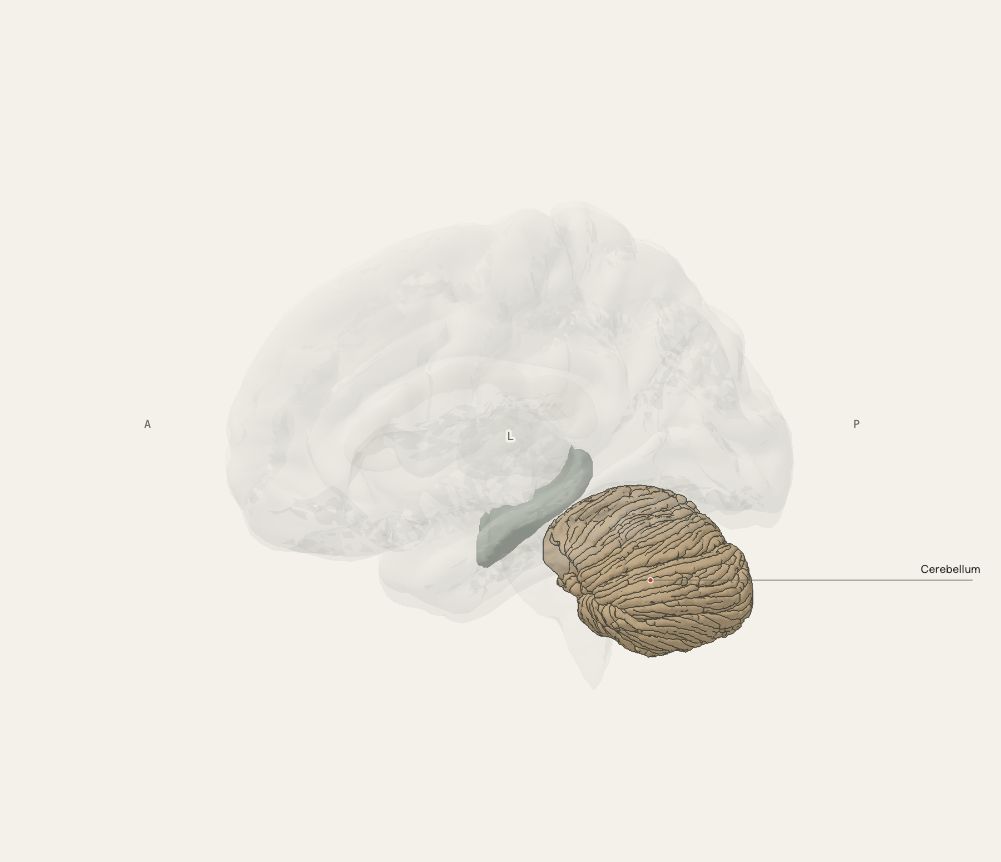
The cerebellum lies below the posterior cerebrum and behind the brainstem. It contributes to movement coordination, balance and motor learning, as well as some cognitive processes.
Where to look in the model
A publicly available high-resolution human cerebellar surface from Sereno and colleagues preserves the original folial geometry. The surfaces were assembled for viewing in Blender.
What this view does not establish
The cerebellum comes from a different research specimen. Its placement in the whole-brain view is schematic and has not been medically registered across templates. Lobules and nuclei are not individually labelled.
Open in 3DSources and precision
Cortex uses the FreeSurfer fsaverage5 template surface, with 10,242 vertices per hemisphere. Functional references use selected Destrieux sulcal and gyral parcels. Deep structures use fsaverage aseg segmentations. The Sereno2020 cerebellar research surface preserves folial geometry, but comes from another specimen; its assembled placement is schematic, without medical registration across templates. Arterial paths are manually drawn teaching schematics, not CTA/MRA reconstructions.
An educational schematic prototype for understanding spatial relationships. Item-by-item independent neuroanatomical review is pending. Functional highlights are not results of an individual examination and do not support individual diagnosis or treatment decisions.